The Problem of Democracy by Alain de Benoist & Tomislav Sunic
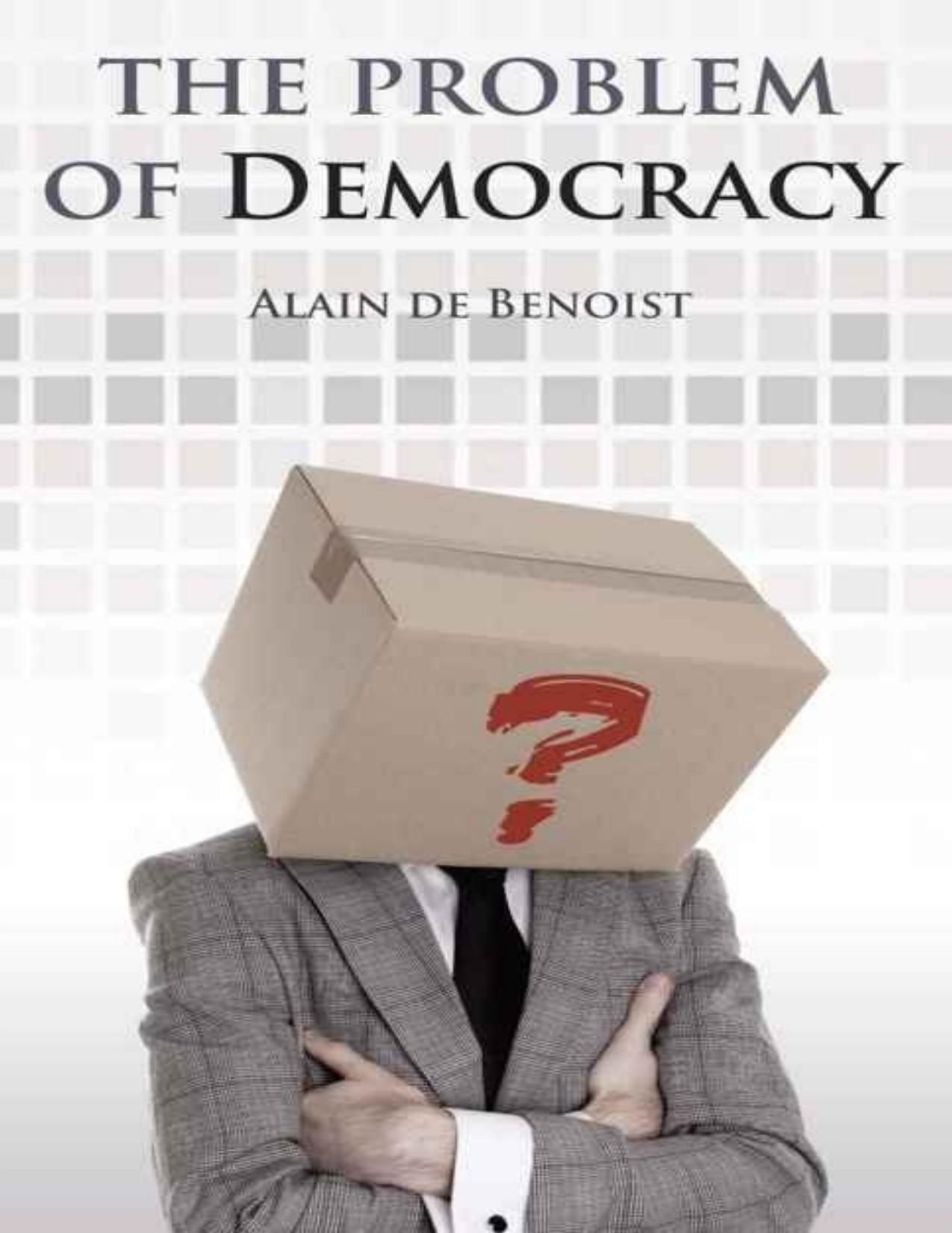
Author:Alain de Benoist & Tomislav Sunic [Benoist, Alain de & Sunic, Tomislav]
Language: eng
Format: epub, pdf
Tags: Politics & Social Sciences, Philosophy, Political, Politics & Government, Ideologies & Doctrines, Democracy
ISBN: 9781907166167
Amazon: B007TXXOYU
Publisher: Arktos
Published: 2011-01-10T23:00:00+00:00
Locke[6] and Montesquieu have spoken in favour of the separation of powers without dismissing the possibility of delegating popular sovereignty to these powers. This theory of the separation of powers derives from the premises of liberal doctrine. It, too, represents a way for the bourgeoisie to divide sovereignty over which it cannot directly exercise perfect control. Such a theory is rarely applied in practice. Judicial power has never really been separate from the others and has never really constituted a political power. The separation between legislative and executive power has, in most cases, been merely formal. The coalescing of powers into the executive continues to be the general rule. Parliaments, which in liberal democracies are meant to express the general will, have almost everywhere experienced a loss of power, both in terms of rights and in actual practice. We are heading towards princedom.
Rousseau, in contrast, rejects all forms of representation. The people, in his view, are not the signatory of any contract with the sovereign: the relation between the two parties is exclusively based on the law. The prince is merely he who executes the will of the people, for the latter remains the sole repository of legislative power. The prince is not the representative of the general will, but merely its instrument: it is the people which govern through him. Magistrates are elected, but they do not represent their electors. The people delegate their power but never forego it. The underlying reasoning here is an extremely logical one: if the people are represented, then it is its representatives who are the power-holders, in which case the people are no longer sovereign. According to Rousseau, then, popular sovereignty is indivisible and inalienable. All representation is abdication.[7]
Download
The Problem of Democracy by Alain de Benoist & Tomislav Sunic.pdf
This site does not store any files on its server. We only index and link to content provided by other sites. Please contact the content providers to delete copyright contents if any and email us, we'll remove relevant links or contents immediately.
| Anthropology | Archaeology |
| Philosophy | Politics & Government |
| Social Sciences | Sociology |
| Women's Studies |
The Secret History by Donna Tartt(19103)
The Social Justice Warrior Handbook by Lisa De Pasquale(12197)
Thirteen Reasons Why by Jay Asher(8919)
This Is How You Lose Her by Junot Diaz(6894)
Weapons of Math Destruction by Cathy O'Neil(6285)
Zero to One by Peter Thiel(5808)
Beartown by Fredrik Backman(5768)
The Myth of the Strong Leader by Archie Brown(5513)
The Fire Next Time by James Baldwin(5454)
How Democracies Die by Steven Levitsky & Daniel Ziblatt(5225)
Promise Me, Dad by Joe Biden(5157)
Stone's Rules by Roger Stone(5091)
A Higher Loyalty: Truth, Lies, and Leadership by James Comey(4967)
100 Deadly Skills by Clint Emerson(4932)
Rise and Kill First by Ronen Bergman(4797)
Secrecy World by Jake Bernstein(4756)
The David Icke Guide to the Global Conspiracy (and how to end it) by David Icke(4724)
The Farm by Tom Rob Smith(4517)
The Doomsday Machine by Daniel Ellsberg(4493)
